KTM 990 RC R (2025) - Review


BikeSocial Road Tester
09.01.2026


Technical Review: Ben Purvis - May 2024
Riding Review : Adam 'Chad' Child - Jan 2026
£13,499 OTR
126bhp
195kg (wet)
5/5
Nearly a decade ago, KTM walked away from the superbike arena, shelving the 1190 RC8 R and declaring that ever-escalating power figures were making superbikes increasingly impractical for real-world riders. Fast-forward to today, and the new 990 RC R signals a bold return—though this time KTM is targeting the fiercely competitive middleweight sportsbike segment rather than chasing outright superbike supremacy.
Sportsbike fans have been waiting what feels like an eternity for this machine. We first glimpsed the MotoGP-inspired 947cc prototype back in early 2024, but KTM’s well-documented financial turbulence delayed its arrival. Now, the dramatically styled 990 RC R is finally here—and KTM clearly means business. To prove the point, they gave us two full days of testing: Spanish roads on Michelin Power Cup 2s, followed by a track session on slicks.
So, does the 990 RC R deliver the thrills its looks promise—and can it still work as a road bike? We headed to a scorching southern Europe to find out.
Finally KTM returns to the sports bike market after a decade
High-end suspension
Touch-screen dash, built-in navigation
Easy handling on road and track with a lazy and easy-to-use motor.
126hp doesn’t seem a lot from 947cc
Demo mode splits opinion
Front end feel has its limitations
Poor mirrors


2025 KTM 990 RC R - Price & PCP Deals
KTM’s lead-in to the 990 RC R has been a couple of runs of limited-edition track-only bikes, the RC 8C. First unveiled in 2021 and with a second coming in 2023, those bikes were based on the Kramer GP2-R and built out-of-house by Kramer, with small production runs of 100 for the first-gen and 200 for the second model, each selling out instantly despite vastly expensive price tags - £30,999 for the first run, £34,999 for the second-gen.
KTM announced the bike with minimal information and without a price back in May 2024, with the interim months being somewhat of a rollercoaster.
The confirmed spec was then announced in October 2025, including the all-important price tag of £13,499 OTR leaving the firm’s Head of Global Marketing, Riaan Neveling's, claims of “This bike offers power and prestige without the exorbitant price tag” as objective.
With uprated suspension, full bodywork and more power than the 990 Duke that it’s based on, it costs only a fraction more than the Duke’s £12,999. But it’s also intended to be used in World Supersport racing under the ‘Next Generation’ ruleset, which places a price limit of €26,400 on the homologated street versions of the race bikes, including the manufacturer’s compulsory racing kit. That’s equivalent to £22,750, and without the racing kit the figure is sure to be substantially lower than that. Given that a Ducati Panigale V2, also aimed at the ‘Next Generation’ race class and making substantially more power in street form than the KTM can muster, is £17,195.
While the components scream premium, the base bike undercuts expectations at £13,499. There’s a catch, though. After 1,500km in Demo Mode, owners must choose which electronic aids they want to keep. The Track Pack costs £452, while the full Tech Pack (including Track) is £896, pushing the real-world price of our test bike to £15,346.
Sample PCP deal (Jan 2026):
On‑the‑Road Price: £13,499
Customer Deposit (10%): £1349.90
Repayment Term: 36 monthly payments
Monthly Payment: £237.00
Optional Final Payment: £6,736.25
Fixed Interest Rate: 4.84% per annum
Representative APR: 9.4% APR
Total Amount Payable: £15,410.25
Annual Mileage Allowed: 2,500 miles


2025 KTM 990 RC R - Engine & Performance
The 990 RC R’s power comes from essentially the same parallel twin engine that drives the current 990 Duke. New in 2024, it’s the second generation of ‘LC8c’ twin – carrying over the same general layout as the previous ‘890’ and ‘790’ versions but completely redesigned with new cases, cylinders and head as well as all-new internals.
With a 70.4mm stroke and 92.5mm bore, the total capacity actually measures 947cc, and while KTM is keeping its cards close to its chest at the moment it doesn’t seem that any major alterations have been made from the Duke-spec engine for the 990 RC R. Peak torque, which is largely defined by the engine’s capacity, is unchanged at 103Nm (76lb-ft), and power rises only slightly from the Duke’s 121.4hp (123PS/90.5kW) to 126hp (128PS/94kW). Peak revs also rise from the Duke’s 9,500rpm to 10,300rpm. Some of that extra power comes courtesy of the Akrapovic exhaust.
Like the Duke’s version of the engine, the RC R’s motor meets the latest Euro 5+ emissions rules, as required for street use, and we can be sure it will at least match the Duke in terms of riding modes (three for the Duke, with a fourth, optional, track mode that can be unlocked via software).
On the ride, I started out in Street mode, rolling out of the Seville paddock and heading for the mountains. First impressions were spot on: super-clean low-speed fuelling and a slick optional quickshifter that works just as well at low rpm as it does when you’re giving it some.
Swapping between Street and Sport takes seconds, which makes it easy to dig into what this new KTM is really about, torque and midrange. I occasionally dropped a couple of gears looking for extra punch, but honestly, there was no need. Peak torque arrives early, at just 6,750rpm, and the drive is far stronger than a traditional inline-four 600. Even low down, it’s urgent, which makes the 990 far more usable and far easier to ride in the real world.
On track, I switched to Track mode. With just 130PS (128bhp), I wasn’t expecting a big step up from Sport, but the throttle response is noticeably sharper without ever being snatchy. The RC R drives even harder off corners, again thanks to that fat spread of torque. It’s all about drive, not chasing the redline.
Yes, it lacks the top-end hysteria of bikes like the CBR600RR or ZX-6R, which need every last rev wrung from them. But this KTM twin is easier to ride quickly. A bit lazier, maybe, but still seriously fast.
That torque also makes it incredibly versatile. Corners I’d normally tackle in second were easily dealt with in third. You can short-shift, forget about lap times, and just enjoy riding. It doesn’t feel fast, but it is which makes it ideal for new or experienced trackday riders. Old-school Ducati fans will recognise the trait; bikes like the 996 and 998 were the same loads of torque, deceptively quick, and all the better for it.


2025 KTM 990 RC R- Handling & Suspension (inc. Weight & Brakes)
As with the engine, the essence of the 990 RC R’s chassis is ported across from the 990 Duke. That’s a huge departure from the RC 8C track bikes, which used their own, Kramer-made tubular steel chassis, but KTM has tweaked the Duke’s frame design for the new sports bike.
The most noticeable visual alteration is an extra bolt that’s fitted through each main frame tube just above the foot pegs. This is part of a redesigned rear suspension system, providing an upper mount for a linkage that runs back to a rocker mounted in the swingarm, the other end of which compresses the rear shock.
KTM also says the frame’s rigidity has been increased to improve feel and stability on track, and that the weight distribution is moved forward compared to the Duke. Surprisingly, though, the rake has been revised to 25 degrees, which is slightly more relaxed than the 24.2 degrees of the 990 Duke.
The WP APEX suspension works without fuss on uneven roads, soaking up bumps and undulations with ease. It’s not soft, plush is a better word and certainly not what you’d expect from a bike that looks this radical. Rather than feeling track-focused, the chassis feels deliberately tuned for real roads. We hit a stretch of tight, grippy mountain switchbacks with zero traffic which quickly turned into an exercise to see just how sporty the 990 RC R is. Despite pushing hard on unfamiliar roads the suspension, previously relaxed and compliant, delivered enough support and feedback to let me attack with confidence.
Steering is excellent. Not razor-sharp, but relaxed, accurate and predictable. The race-spec Brembo HyPure calipers with 320mm discs look intimidating, but on the road they’re more about feel than outright bite, letting you trail the brakes neatly to the apex. There are four ABS modes, (Street, Sport, Supermoto+ and Supermoto), with the latter two ditching cornering ABS altogether.
On track, it was time to dial in the suspension as we reached the limits of the standard setup. I added preload and rebound at the fork tops for extra support, left compression alone, and firmed up the rear shock all quick and easy. I kept the footpegs in their road position as ground clearance wasn’t an issue, and I prefer the roomier feel.
The HyPure brakes showed no sign of fade and remained strong without being overly aggressive. I might have expected a little more outright punch, but the feel was superb, and the ABS in Supermoto or Supermoto+ stayed well out of the way. If I’m being picky, I’d like more engine-braking options; occasionally the bike ran into corners a bit too eagerly, almost two-stroke-like, and that sensation was more noticeable on track than on the road.
Front-end feel on track was a solid nine out of ten… very good but not perfect at the limit. That’s subjective and likely influenced by our track day tyres. The relatively large 33mm fork offset and reduced trail compared to the 990 Duke may also play a part. Either way, I sometimes had to trust the grip rather than feel it at the apex.
The rear, by contrast, was excellent all day. I could clearly feel the 180-section tyre starting to fall away toward the end of the session, and the connection to the chassis inspires huge confidence. A few progressive, torque-led slides late on had me adding a touch more TC easily done even at race pace via the intuitive left-bar toggle.
Worth mentioning too is the fuel tank shape, with its six dedicated contact points, and the supportive seat. Both really help when you’re hanging off at ridiculous angles for the camera.


2025 KTM 990 RC R - Comfort & Economy
KTM puts great stake in the ergonomics of the 990 RC R – which bodes well for riders when it comes to controlling the bike.
The firm says that it’s done lengthy experiments on the ‘six contact points on the tank’ to improve the rider experience both in corners and when tucking-in on the straights, making it comfortable and reducing the pressure on the rider’s hands that comes from the forward-hunched riding position.
The footpegs are adjustable over a wide range of positions and the race-inspired bodywork has clearly been developed with the RC16 MotoGP bike as its template, with biplane front winglets and intriguing air guides at the front lower edges of the fairing. It also features a GP-style scoop under the belly, just ahead of the rear wheel, to pull air up before it hits the back tyre. Does the aero translate into road-going comfort or work only when you’re in a full-race crouch? Well that depends if your name is Dani Pedrosa or not.
In terms of economy the bike’s close relationship to the 990 Duke means that the consumption isn’t likely to be too far from the equivalent 55-60mpg.
On the road, the flat, race-style 845mm seat is roomy and comfortable, the screen is nicely tall, and the bars are wide and relaxed. The standard pegs offer two positions: race and road, and in the road setting they only add to the sense of space.
At motorway speeds on fast A-roads, the 990 RC R’s practical side really comes through. Sitting upright, the screen and bodywork take the sting out of the windblast; tuck in and it’s even better, with plenty of room to do so. Optional cruise control sweetens the deal, and with the pegs in the lower position you could cover serious miles — something ZX-6R or CBR600RR owners can only wish for.
I even managed to find the worst road in Spain, and yet the standard WP APEX suspension just got on with it. On rough, unfamiliar roads ridden at pace, the KTM felt completely in its element. The riding position is commanding and comfortable, and the ride quality is genuinely impressive.

2025 KTM 990 RC R - Equipment
KTM is usually near the front of the pack when it comes to electronic equipment on its bikes and the 990 RC R’s package sure ticks most of the right boxes.
As well as multiple riding modes, like the 990 Duke, there’s an up/down quickshifter, cornering ABS and cornering traction control.
The standout feature is the 8.8-inch touchscreen. It’s a bit fiddly to use in race gloves, but you rarely need to touch it anyway thanks to the new, intuitive switchgear. The display itself is clear, easy to customise, and genuinely useful. The integrated sat-nav, for example, can sit neatly in a small split-screen window or take over the dash entirely if you want it front and centre.
2025 KTM 990 RC R - Rivals
As a machine intended to compete in Supersport racing it’s not hard to see the bikes it will be competing against on the track. The same bikes will also provide its toughest competition on the road, so buyers will be comparing against:
Ducati Panigale V2 | Price: £17,195

![Ducati Panigale V2 2020 [ Review ]](https://www.datocms-assets.com/119921/1714065234-ducati-panigale-v2_058.jpg?auto=format&w=700)
155bhp/77lb-ft
193kg (wet)
MV Agusta F3 800 RR | Price: £21,700
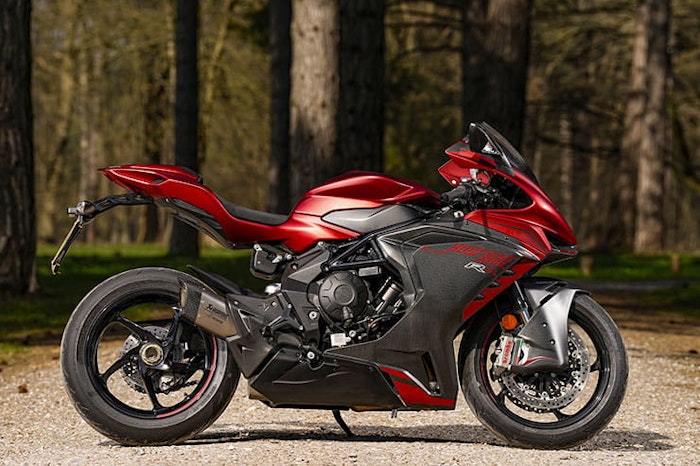
147bhp/65lb-ft
199kg (wet)
Honda CBR600RR | Price: £10,499
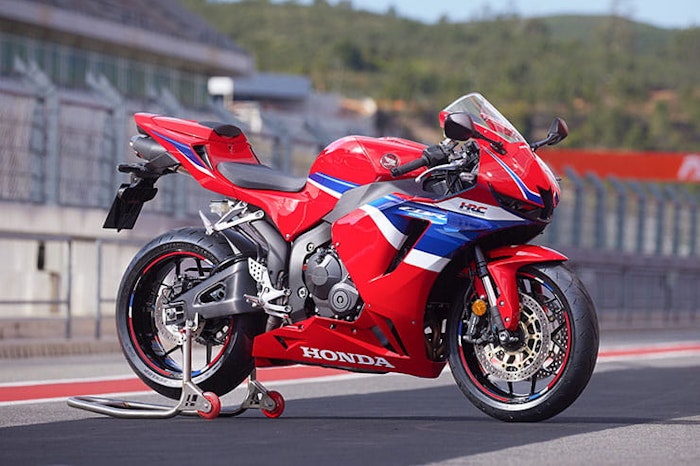
119bhp/46.5lb-ft
193kg (wet)

2025 KTM 990 RC R - Verdict
KTM needed to deliver something special to restore confidence in the brand and after two days of riding, it looks like they have. Making a middleweight sports bike that works on both road and track is no easy task, but KTM has nailed it. It’s an easy 5 out of 5 from me.
It looks dramatic, like a scaled-down MotoGP bike, yet it’s genuinely usable day to day. The ergonomics are spot on, the dash is class-leading, and there’s serious midrange punch backed up by rider aids that are powerful but easy to access. The mirrors are poor and I’d like more engine braking, but those are minor gripes.
On track, it’s just as impressive. It’s easy to ride fast and, once again, the torque is the star. The Brembo HyPure brakes are excellent, the chassis delivers strong feedback, and the electronics complement rather than complicate the riding experience, with plenty of scope to tailor them to your mood or ability. Front-end feel at the limit is good rather than outstanding and, being a relaxed twin rather than a screaming inline-four, it’s perhaps not quite as thrilling as it looks.
KTM’s Demo Mode will divide opinion, and you’ll need to spend an extra £896 to unlock every electronic feature, but that aside it’s hard not to like the 990 RC R. A four-year warranty and long service intervals only add to its appeal.
I’m impressed. I expected a track-focused weapon that would compromise on the road. I was wrong. This is a genuinely great road bike that can be easily set up to shine on track. The real test, though, will come against Ducati and Yamaha — and that’s a comparison we’re very much looking forward to.
If you’d like to chat about this article or anything else biking related, join us and thousands of other riders at the Bennetts BikeSocial Facebook page.

2025 KTM 990 RC R - Technical Specification
| New price | From £13,499 |
| Capacity | 947cc |
| Bore x Stroke | 92.5mm x 70.4mm |
| Engine layout | Parallel twin |
| Engine details | 8-valve, DOHC, parallel twin, liquid-cooled |
| Power | 126bhp (94kW) @ 10,300rpm |
| Torque | 76 lb-ft (103Nm) @ 6750 rpm |
| Transmission | 6 speed |
| Average fuel consumption | Est. 60mpg |
| Tank size | 15.7 litres |
| Max range to empty | +200 miles |
| Rider aids | Four ABS modes, four riding modes, 6D IMU |
| Frame | Chrome molybdenum steel tube frame, engine as stressed member |
| Front suspension | WP Apex Open Cartridge 48mm forks |
| Front suspension adjustment | Compression, rebound and preload |
| Rear suspension | WP Apex monoshock |
| Rear suspension adjustment | Compression, rebound, preload |
| Front brake | 2 x 320mm discs, Brembo HyPure 4-piston radial calipers |
| Rear brake | 1 x 240mm disc, Brembo 1-piston caliper |
| Front wheel / tyre | 180/55 R17 Michelin Power Cup 2 |
| Rear wheel / tyre | 120/70 R17 Michelin Power Cup 2 |
| Dimensions (LxWxH) | TBA |
| Wheelbase | 1481mm |
| Seat height | 845mm |
| Weight | 195kg (fully fuelled) |
| Warranty | 4-years |
| Servicing | TBC |
| MCIA Secured Rating | Not yet rated |
| Website | www.ktm.com |

What is MCIA Secured?
MCIA Secured gives bike buyers the chance to see just how much work a manufacturer has put into making their new investment as resistant to theft as possible.
As we all know, the more security you use, the less chance there is of your bike being stolen. In fact, based on research by Bennetts, using a disc lock makes your machine three times less likely to be stolen, while heavy duty kit can make it less likely to be stolen than a car. For reviews of the best security products, click here.
MCIA Secured gives motorcycles a rating out of five stars (three stars for bikes of 125cc or less), based on the following being fitted to a new bike as standard:
A steering lock that meets the UNECE 62 standard
An ignition immobiliser system
A vehicle marking system
An alarm system
A vehicle tracking system with subscription
The higher the star rating, the better the security, so always ask your dealer what rating your bike has and compare it to other machines on your shortlist.

Getting a motorcycle insurance quote with Bennetts is easy.
We compare prices from our panel of top-tier insurers, to find riders our best price for the cover they need. With common modifications covered as standard, our policies are rated Excellent on Trustpilot and 5 stars by Defaqto. We are an award-winning UK broker, with a UK-based contact centre and 24/7 claims support.
Buy direct or renew at bennetts.co.uk, or via our contact centre, to gain access to a free BikeSocial Membership - unlocking discounts on kit, tyres, training, and exclusive customer-only VIP experiences.


